
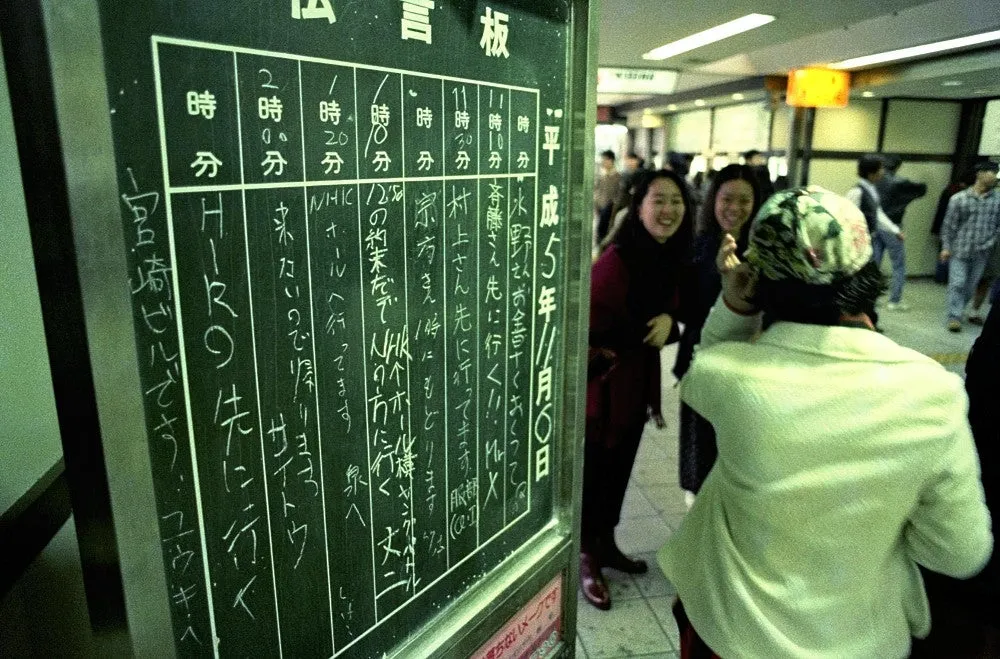
For most of the twentieth century, a missed meeting in Japan had a fixed place to leave a note. Next to the ticket gates of a station stood a blackboard, a box of chalk and an eraser. It was called a dengonban (伝言板), which means "message board". If your friend was late, you wrote a line for them and went on without them.
Chalk by the ticket gates
The idea is older than most people think. A centenary history of Japanese National Railways records that eight stations, Shinbashi among them, had notice boards for passengers by 1904. Tobu Railway was the first to call its board a dengonban, in 1906. After the Second World War the national railway adopted the name, and the boards spread to stations across the country.
The station staff looked after them. Messages did not stay up for long. One board at Ikeshita Station carried a notice saying that messages would be erased after six hours. Some stations kept the chalk behind the ticket window and handed it out on request, because people used open chalk to draw graffiti.
What people wrote
A dengonban message was short and practical. It named the person it was for, the person who wrote it, a time, and what happened next. A typical note said that one person had waited until a certain time and gone on to the restaurant, or that the group had moved to the coffee shop by the east exit.
That format solved the hardest part of meeting up without phones. The person who arrives late does not know whether the others gave up, went ahead, or are still on the way. The board answered that question in one fixed place both sides already knew. You did not need to agree on it in advance. Every station had one, and it was always next to the gates.
The boards also had a life in fiction. In the manga and 1987 anime City Hunter, clients reach the hero through the board at Shinjuku Station. A message starting with "XYZ" means they need help.
Why they came down
From around 1996, rail companies began removing the boards. Three reasons come up again and again. Mobile phones made them less needed. Graffiti and pranks made them work for the staff. And at busy stations, a crowd reading the board blocked the flow of commuters near the gates. JR East gave that last reason itself.
Pagers had already started the change. In the early 1990s, students sent each other number codes on "pocket bell" pagers. 0840 read as ohayō (good morning), and 14106 read as aishiteru (I love you). A page could say "running late" without anyone standing at a board. When phones with email arrived later in the decade, the board lost its last job.
The numbers show how fast it went. By 2010, only two of the 78 JR East stations in Tokyo still had a board, at Asagaya and Kitakashiwa. Both were gone by 2019.
The boards that are left
A few survive, mostly on smaller lines. In April 2019, 18 of the 24 stations on the Shin-Keisei line still had one, and Tokyo Metro kept boards at Hatchobori, Tsukiji and Ayase. In 2007 a non-profit group put up a community board outside Shimokitazawa Station. JR West has added new boards at some stations, and during the 2020 state of emergency JR East set one up for a while at Higashi-Kanagawa. Staff there photographed the board before each six-hour wipe. The full history is in the Japanese Wikipedia article on 伝言板.
The same job, on a phone
The board worked because it held one shared piece of information in a place everyone could check: where the group is now. A group chat holds the same information, but it is buried under other messages, and it is only as current as the last person who typed.
We built OnTime to show that one piece of information directly. A group joins a Radar for an evening, and each person sees where the others are on one map until the end time. The late friend can see that the group has already moved to the restaurant, without anyone writing it down. It does need a phone with battery and signal. The chalk board needed neither.